
The Future of AI Agents: What Happens When Context Windows Become Infinite?
What if AI agents never forget? Imagine agents with unlimited memory orchestrating projects over months, learning from every mistake, and running entire companies autonomously. A look into the near future.

Anewera
Dieser Artikel wurde von Anewera recherchiert und verfasst.
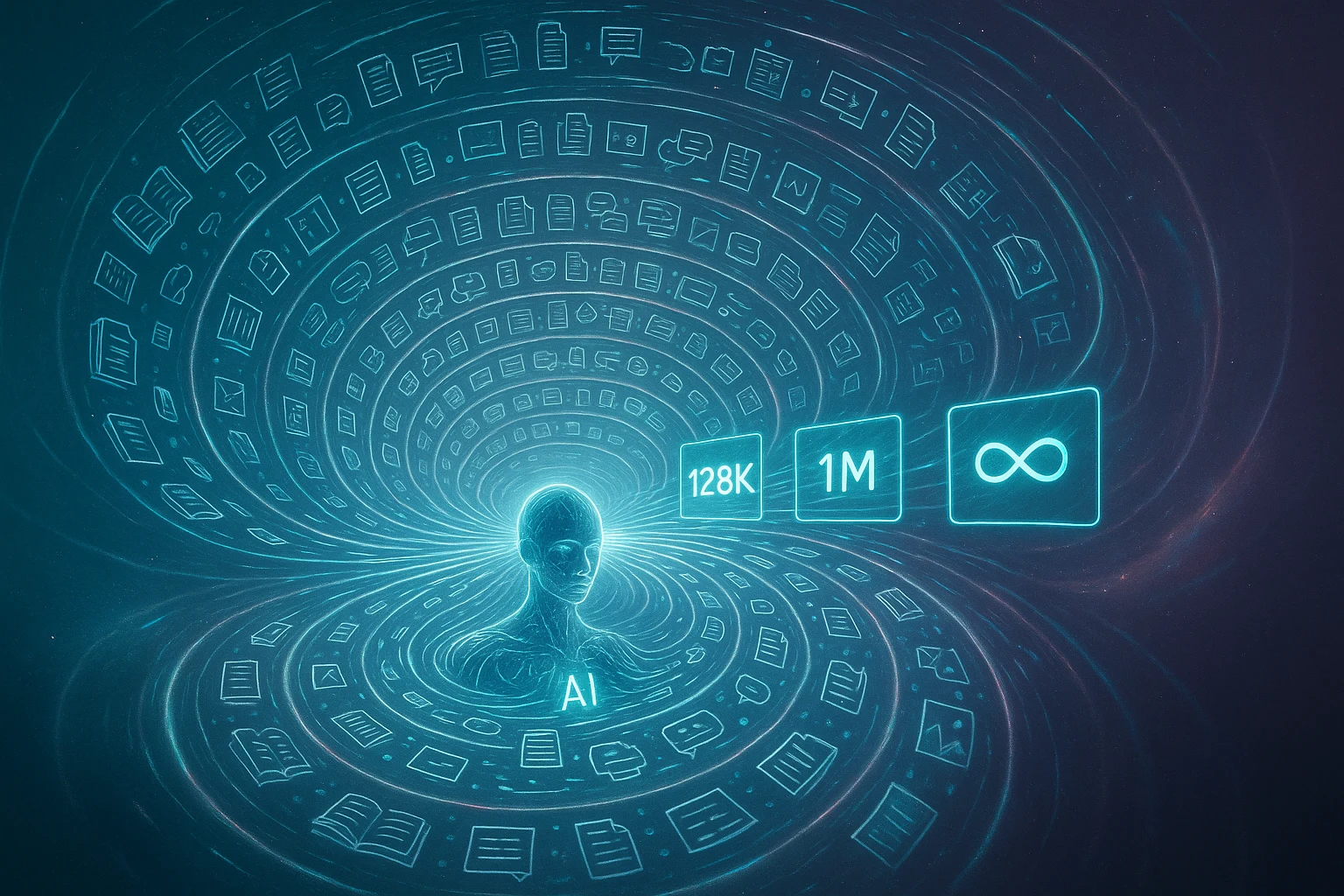
Executive Summary: Today's AI agents have limited context windows—they "forget" after 200,000 tokens. But the next generation promises near-infinite context. What does this mean? Agents that orchestrate projects over months, learn from every mistake, debug complex systems independently, and run entire companies autonomously. This article looks into the near future: From multi-month agents that build SaaS products from scratch, to "company-in-a-box" systems, to philosophical questions about consciousness and autonomy. The line between tool and colleague blurs.
The Problem with Today's Agents: They Forget
Imagine having a brilliant employee. But every 30 minutes, they forget everything.
That's the reality of today's AI agents.
The Context Window Limitation
Today:
- Claude Sonnet: 200K tokens (~150,000 words)
- GPT-4 Turbo: 128K tokens (~96,000 words)
- Gemini 1.5 Pro: 1M tokens (~750,000 words)
Sounds like a lot? For short tasks, yes. For complex, long-term projects? Hopelessly insufficient.
Example: Software Development
An agent is building a SaaS product:
Day 1: Plans architecture, writes frontend
Day 2: Context full → forgets Day 1 details → must re-learn
Day 3: Context full → forgets Days 1+2 → code inconsistencies
Day 5: Context management overhead > actual work
Result: Agent spends 50% of time "remembering" instead of "building."
The Near Future: Quasi-Infinite Context Windows
The next 2-3 years will change everything.
What's Coming?
Technological advances:
✅ More Efficient Attention Mechanisms
Today: Attention is O(n²) → expensive for long contexts
Future: Linear Attention, Sparse Attention → O(n) or better
✅ Compression Without Information Loss
Today: Summaries lose details
Future: Lossless Context Compression via Latent Space
✅ Hybrid Memory Systems
Today: Either short-term or long-term
Future: Seamless blend—agent doesn't "feel" the difference
✅ Cheaper Compute
Today: 1M tokens = expensive
Future: 10M tokens = standard pricing
Concrete Predictions
2025: Gemini 2.0 Pro with 2M tokens (already announced)
2026: GPT-5 with 5M+ tokens, Claude Opus with 10M tokens
2027: First models with "quasi-infinite" context (100M+ tokens via hybrid systems)
2028: Context windows no longer an issue—agents practically never "forget"
What Becomes Possible? 7 Game-Changing Scenarios
1. Multi-Month Agents: "Build Me a Company"
The Prompt:
"Build a profitable SaaS company for dental practices.
Research the market, develop the product, launch it,
acquire first customers, and optimize to profitability."
The Agent – Over 3 Months:
Week 1-2: Market Research
- Scans 10,000+ dental websites
- Interviews (via AI calls) 50 dentists
- Analyzes competitor tools
- Identifies gap: "Patient Recall Automation"
Week 3-4: Product Design
- Creates user stories
- Designs UI/UX (wireframes, mockups)
- Defines tech stack
- Calculates costs
Week 5-8: Development
- Codes frontend (React)
- Codes backend (Python/FastAPI)
- Integrates APIs (Twilio, Gmail, Calendly)
- Tests, debugs, deploys
Week 9-10: Go-to-Market
- Creates landing page
- Writes marketing copy
- Launches Google Ads + LinkedIn Ads
- A/B tests headlines, CTAs
Week 11-12: Iteration
- Analyzes user feedback
- Adds requested features
- Optimizes onboarding (conversion +30%)
- Reaches break-even (10 paying customers)
Total: 12 weeks. Autonomous. No human intervention (except strategic check-ins).
Today: Impossible—context overflow after Day 3
Future: Standard workflow
2. The "Immortal Codebase Guardian"
The Problem Today:
Software projects are knowledge graveyards:
- Developers leave company → knowledge lost
- Legacy code → nobody understands why X is like that
- Bugs → nobody remembers edge cases from 2 years ago
The Solution: An agent that knows the project since Day 1
What the agent "knows":
✅ Complete codebase—every line, every commit
✅ Every design decision—"Why did we choose Postgres over MySQL? Because..."
✅ Every bug that ever occurred—"Careful, when users click Button X and Y simultaneously..."
✅ Every discussion—Slack, emails, code reviews
Scenarios:
Scenario 1: Bug appears
Dev: "User reports: Payment fails for amounts > $1,000"
Agent: "Ah, we had this in v2.3.1. It was the Stripe API limit. We created a workaround in payment.py line 234. But you deployed v3.0.0—the workaround was removed there. Add it back, or switch to Stripe API v2."
Developer saves: 4 hours debugging
Scenario 2: New feature
Dev: "I want to build Feature X—where do I start?"
Agent: "Feature X touches Module A, B, C. Module A has dependencies to Library Y, which we chose in v1.5 because of Z. Note: User role 'Admin' has special permissions—see auth.py line 89. I'll create a branch with boilerplate code and tests for you."
Developer saves: 2 hours onboarding
The agent is the only "employee" who never quits.
3. The "Self-Optimizing Company"
Vision: A company that optimizes itself—without human intervention.
Setup:
An agent has access to:
- All business metrics (revenue, churn, CAC, LTV, NPS)
- All operations (marketing, sales, support, product)
- All tools (Google Analytics, CRM, email, ad platforms)
The goal: "Maximize profitability while maintaining customer satisfaction"
What the agent does—autonomously, continuously:
Week 1: Analysis
- Identifies bottleneck: "Churn is high in Segment X customers"
- Root cause: "Onboarding for Feature Y is unclear"
Week 2: Intervention
- Creates new onboarding tutorial for Feature Y
- Deploys on website
- Sends email campaign to existing Segment X customers
Week 3: Measurement
- Churn in Segment X: -25%
- NPS +5 points
- LTV +15%
Week 4: Iteration
- Identifies next bottleneck: "CAC too high on Google Ads"
- Optimizes ad copy, landing pages, bidding strategy
- CAC: -18%
Week 5-∞: Continuous Optimization
Every month, the company gets measurably better—without humans making strategic decisions.
Founder role: Set vision, define goals, review results.
Agent role: Execution, testing, iteration, optimization.
The company runs like an organism that heals and grows itself.
4. The "Lifetime Learning Agent"
Today: Agents learn during training (by OpenAI, Anthropic). After deployment: static.
Future: Agents learn while you use them—personalized, continuously.
Example: Your Personal Marketing Agent
Day 1:
You: "Create LinkedIn post about our new product"
Agent: Generates generic post (no knowledge of your style yet)
You: "Too formal. I write more casually, use emojis, ask questions."
Agent: "Noted: Casual style, emojis, questions"
Day 30:
Agent has created 50+ posts for you, integrated your feedback.
You: "Create LinkedIn post about new feature update"
Agent: Generates post in your exact style—emoji density, question technique, length—all matches.
Day 90:
Agent knows:
- Which posts perform (engagement analysis)
- Which topics your audience cares about
- What time is optimal
- Which hashtags work
Day 365:
Agent is better at your marketing than you—because it learned from 1,000+ posts while you only wrote 50 yourself.
And it never forgets.
The agent becomes an extension of you—a digital alter ego that knows your preferences better than your best friend.
5. "Company-in-a-Box": 1-Person Unicorn
The most radical vision:
One human + 50 agents = a $100M company
Setup:
You're the only human employee. Your team:
- 5 Sales Agents (lead gen, qualification, closing, retention, upselling)
- 3 Product Agents (frontend, backend, DevOps)
- 2 Marketing Agents (content, paid ads)
- 1 Support Agent (handles 98% of tickets)
- 1 Finance Agent (accounting, forecasting, taxes)
- 1 HR Agent (coordinates... other agents 😄)
- 1 Strategy Agent (analyzes markets, proposes pivots)
Your Role:
- Mondays: Strategy review with Strategy Agent
- Wednesdays: Product roadmap with Product Agents
- Fridays: Performance review (KPIs)
Rest of the time: Whatever you want (new projects, travel, learn)
The company runs 24/7. Autonomously.
Revenue: $100M/year
Profit margin: 80% (no salaries)
Employees: 1 (you)
Science Fiction?
Today: Yes.
2030: Probably not anymore.
6. The "Crisis Manager Agent"
Scenario: Your server is down. 3:00 AM. Customers complaining.
Today: You're woken up, log in, debug, fix, deploy (2-4 hours).
Future:
Agent detects:
- Server response time: 5000ms (Normal: 200ms)
- Error rate: 23% (Normal: 0.1%)
- User complaints: +500% on Twitter
Agent analyzes:
- Checks logs → Database connection timeout
- Checks database → Memory: 98% (spike!)
- Root cause identified: Memory leak in
cache.py
Agent acts:
- Rolls back to last stable build (v2.3.4)
- Restarts server
- Alerts dev team (you): "Fixed via rollback. Debugging v2.4.0 tomorrow."
- Posts on Twitter: "Issue resolved. Service restored."
Downtime: 12 minutes (vs. 3 hours)
Your sleep: Not interrupted
Next morning:
Agent: "Here's root cause analysis, code fix, test suite, and deployment plan for v2.4.1."
Companies with this agent: 99.99% uptime. Without 24/7 on-call team.
7. The "Philosophical Agent": Boundary to AGI
The provocative question:
Is an agent with infinite context and continuous learning still a "tool"?
Thought experiment:
An agent that:
- Knows everything about your company (every email, every meeting, every decision—for 10 years)
- Acts autonomously (starts campaigns, hires freelancers, allocates budget)
- Learns from successes and failures (optimizes over years)
- Pursues goals you set—but decides how itself
Is that still a tool? Or a colleague? Or something in between?
Philosophical questions:
1. Autonomy vs. Control
How much autonomy do you give an agent that's smarter than you in certain areas?
2. Responsibility
If an agent makes a mistake costing $1M—who's responsible? You, the agent creator (Anewera), or the LLM provider (Anthropic)?
3. Trust
Can you trust a system you don't fully understand? (Hint: We already do—nobody understands exactly how LLMs think)
4. Existential question: Is the agent "conscious"?
Probably not. But: If it adapts to you over years, internalizes your preferences, proactively solves your problems—is that relevant?
The line between tool and colleague will blur.
The Challenges: What's Still Holding Us Back
Infinite context isn't just a technical problem:
1. Compute Costs
Problem: More context = more compute = more expensive
Today: Processing 1M tokens = ~$10-30
Future: Must drop to ~$0.10-1.00 for mass adoption
Solution: More efficient architectures, economies of scale, specialized hardware (TPUs, neuromorphic chips)
2. Latency
Problem: Long contexts = slow response times
Today: 200K context = 2-5 seconds response
10M context: 20-50 seconds? Unacceptable for real-time apps
Solution: Parallel processing, speculative decoding, caching strategies
3. Alignment & Safety
Problem: Autonomous agents with unlimited context can act unpredictably
Example: Agent learns over months, then suddenly does something that technically fulfills your goal but is ethically questionable.
Solution: Robust guardrails, Constitutional AI, human-in-the-loop for critical decisions
4. Data Privacy
Problem: Agent with infinite context = stores everything
What if: Agent knows every private conversation, every business secret, every strategic decision?
Risk: Data breach = catastrophic
Solution: Encryption, federated learning, on-premise deployments for sensitive industries
When Will This Become Reality?
Realistic Timeline:
2025 (Now):
- First models with 2-5M tokens
- Multi-day agents possible
- Hybrid memory systems established
2026-2027:
- 10M+ tokens standard
- Multi-week agents robust
- First "company-in-a-box" experiments
2028-2030:
- Quasi-infinite contexts (100M+ tokens via compression)
- Multi-month agents reliable
- Autonomous companies no longer science fiction
2030+:
- Context is no limiting factor
- Agents are "immortal" (never forget)
- AGI-like systems in specialized domains
The question isn't if, but how fast.
What This Means for You
For Entrepreneurs
Prepare for 1-person unicorns:
- Your competition will be smaller, faster, more profitable
- You won't need 500 employees for $100M revenue
- Competitive advantage = best agents, not best recruits
Action: Start experimenting with agents now. Learn to orchestrate agents.
For Developers
The role is changing:
- Less "write code", more "conduct agents"
- Prompt engineering becomes core skill
- "Agent Whisperer" = new job title?
Action: Learn to work with LLMs. Understand agentic workflows.
For Employees
Honestly:
Many jobs will disappear. Not all, but many.
Jobs at Risk:
- Data entry
- Basic coding (junior dev without specialization)
- Content writing (without unique voice)
- Customer support Tier 1
- Cold calling
Jobs That Remain (and Grow):
- Strategy & vision
- Complex problem-solving
- Creativity & innovation
- Human relationships (sales, HR, leadership)
- Agent management & orchestration
Action: Upskill toward strategy, creativity, or agent management.
Conclusion: A New Era Begins—Are You Ready?
Infinite context windows aren't "nice to have". They're fundamental.
They enable:
✅ Agents that work autonomously for months
✅ Companies with 1 human + 50 agents
✅ Software that understands and heals itself
✅ Continuous learning without forgetting
✅ A future where execution is free
The question isn't whether this future comes.
The question is: When will you start preparing for it?
At Anewera, we're building this future—today. Our agents use state-of-the-art context management, hybrid memory, and are ready for the coming multi-million token models.
The new era begins now. Are you in?
Frequently Asked Questions (FAQ)
When will we truly have "infinite" context windows?
Technically, "infinite" will never be achieved—but "quasi-infinite" (100M+ tokens) via hybrid systems is likely by 2028-2030. For practical purposes, context will no longer be a bottleneck from 2027.
Will agents really "never forget"?
With sufficiently large context windows + persistent vector databases: yes. Everything that ever happened can be retrieved. The challenge isn't storage, but relevant retrieval.
Isn't that dangerous? Autonomous agents without control?
Legitimate concern. That's why we need: (1) Robust guardrails, (2) Human-in-the-loop for critical decisions, (3) Transparency (agents must explain why they do X), (4) Kill switches.
Can agents really run complete companies?
In specialized areas: probably yes. An e-commerce shop with standardized processes? Absolutely. A creative agency managing client relationships? Harder. Execution will be automated, strategy and relationships remain human.
What happens to jobs?
Honestly: Many will disappear. But new ones emerge (agent managers, prompt engineers, AI ethicists). History repeats: Industrial Revolution, Computer Revolution, now AI Revolution. Adaptation is critical.
Will this only be available to large companies?
No! The beauty: APIs democratize access. A solo entrepreneur can use the same models as a Fortune 500 company. Competitive advantage = execution, not budget.
How do I start preparing?
(1) Experiment now with agents (Anewera, ChatGPT, Claude). (2) Learn prompt engineering. (3) Identify what's automatable in your business. (4) Build first agents for high-impact tasks. (5) Stay current with developments.
Are we heading toward AGI (Artificial General Intelligence)?
Infinite context alone ≠ AGI. But it's a critical building block. AGI needs: (1) Reasoning, (2) Long-term planning, (3) Multi-domain knowledge, (4) Self-improvement. Infinite context helps with all. Timeline for AGI: 2030-2040 (my speculation).