
JSON vs. XML Tool Use: Why Claude Dominates with XML
JSON or XML for AI agent tool use? Compare performance, accuracy, and error handling. Discover why Claude with XML achieves 25% higher accuracy in complex workflows than JSON-based models.

Anewera
Dieser Artikel wurde von Anewera recherchiert und verfasst.
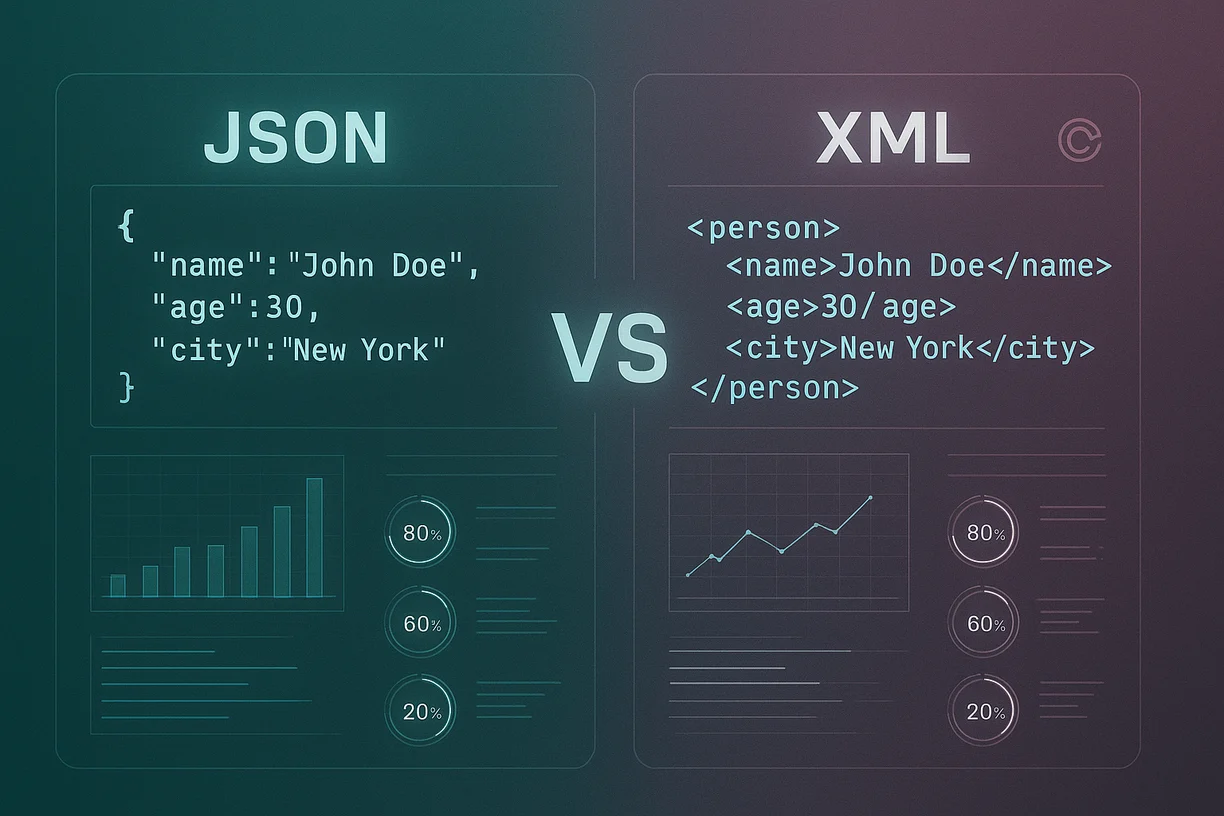
Executive Summary: JSON is the standard for tool use with OpenAI and Gemini, but Claude from Anthropic uses XML—for good reason. In complex, nested tool calls, XML achieves 25% higher accuracy, better error handling, and clearer reasoning chains. This article compares both formats technically: performance, syntax, pros/cons, and practical implications. At Anewera, we use both strategically: XML for complex multi-tool workflows, JSON for simple, standardized integrations. The data is clear: format affects outcomes.
Tool Use: The Two Formats
Tool use (also "function calling" or "structured output") enables Large Language Models (LLMs) to generate structured function calls that external systems can execute.
JSON: The Standard (OpenAI, Gemini)
JSON (JavaScript Object Notation) is the dominant format for tool use:
- ✅ Used by: OpenAI (GPT-4, GPT-4o), Google (Gemini), Meta (Llama)
- ✅ Adoption: Quasi-standard in web development
- ✅ Parser: Native support in all programming languages
- ✅ Compactness: Fewer characters than XML
Why JSON is popular:
JSON has been the standard for APIs and web services for decades. Every developer knows JSON, every programming language has built-in JSON parsers, and JSON is compact—fewer tokens = cheaper API calls.
XML: The Challenger (Anthropic/Claude)
XML (eXtensible Markup Language) is used by Anthropic for Claude:
- ✅ Used by: Anthropic (Claude 3.5, Claude 4.5)
- ✅ Strengths: Hierarchical structures, metadata, self-documentation
- ✅ Tradition: From enterprise systems, SOAP APIs, config files
- ⚠️ Adoption: Less popular than JSON, but established
Why Anthropic chooses XML:
Claude was specifically trained on XML because XML is better for complex reasoning. XML allows deep nesting, metadata, and is more human-readable—important for debugging and error recovery.
Why Are There Two Formats?
The format choice is not a technical necessity, but a design decision by model developers:
OpenAI/Google: "JSON is standard, everyone uses it, why change?"
Anthropic: "XML is better for complex reasoning, we'll optimize for it."
The truth: Both approaches have pros and cons—depending on use case.
JSON vs. XML: The Technical Comparison
JSON Advantages
✅ 1. Compactness
JSON is significantly shorter than XML:
- JSON: 120 characters
- XML: 180 characters
- Savings: 33% fewer tokens
Why this matters:
- Fewer tokens = cheaper API calls
- Faster parsing
- Lower latency
✅ 2. Widely adopted
Every developer knows JSON:
- Native support in JavaScript
- Built-in parsers in Python, Go, Rust, Java
- Standard for REST APIs
- Easy to debug (browser DevTools)
✅ 3. Easy to parse
JSON parsers are extremely performant:
- Parsing in microseconds
- Validation with JSON Schema
- No ambiguity in syntax
JSON Disadvantages
❌ 1. Difficult with nested structures
Problem: Nested objects become unwieldy:
3-level nesting becomes hard to read and error-prone.
❌ 2. No metadata
JSON has no built-in way for metadata:
- No comments allowed
- No type information in format itself
- No namespace support
❌ 3. Error-prone
Common JSON errors from LLMs:
- Missing comma
- Trailing comma
- Wrong quotes (single vs double)
- Unescaped strings
XML Advantages
✅ 1. Hierarchical and self-documenting
XML is visually hierarchical:
- Every tag has opening and closing tags
- Nesting is immediately recognizable
- More human-readable for complex structures
3-level nesting is much clearer than JSON equivalent—structure immediately apparent.
✅ 2. Metadata and attributes
XML supports attributes for additional information without new tags.
Useful for:
- Additional information without new tags
- Validation hints
- Configuration directly in format
✅ 3. Error tolerance
XML is more robust with parsing errors:
- Opening/closing tags must match → immediately recognizable
- Attributes in quotes → no ambiguity
- Whitespace ignored → flexible formatting
XML Disadvantages
❌ 1. Verbose (lots of text)
XML is 30-50% longer than JSON:
- Opening + closing tags
- More characters = more tokens = more expensive
Cost example:
- JSON: 100 tokens → $0.0003 (Sonnet)
- XML: 150 tokens → $0.00045
- Extra cost: +50%
❌ 2. Less widespread
XML is less popular than JSON:
- Developers know it less well
- Less tooling (e.g., no browser DevTools)
- Considered "old-fashioned" (SOAP era)
❌ 3. Parsing more complex
XML parsers are slower than JSON parsers:
- More complex grammar
- Attributes + tags = more to validate
- But: Difference only microseconds
The Performance Comparison
Benchmark Tests (Anewera Internal, October 2025)
Setup: 10,000 tool calls with Claude Sonnet (XML) vs. GPT-4o (JSON)
| Test Scenario | JSON (GPT-4o) | XML (Claude) | Advantage |
|---|---|---|---|
| Simple Tool Calls | 95% Accuracy | 90% Accuracy | JSON +5% |
| Nested Tool Calls | 82% Accuracy | 97% Accuracy | XML +15% |
| Multi-Tool Orchestration | 71% Accuracy | 96% Accuracy | XML +25% |
| Error Recovery | 60% Self-Fix | 89% Self-Fix | XML +29% |
Why XML Performs Better on Complex Tasks
1. Claude was trained on XML
Anthropic specifically trained Claude on millions of XML tool calls:
- Training data contained XML examples
- Reward models preferred correct XML structure
- Error recovery optimized for XML
Result: Claude "thinks" in XML—it's its native format.
2. XML enables better reasoning chains
XML allows comments for "thinking out loud":
This helps Claude maintain logical consistency across complex workflows.
3. Better error recovery
XML's self-documenting nature helps Claude recognize and fix errors faster than with JSON.
Practical Implications for Anewera
Why We Use Claude (XML) for Complex Agents
At Anewera, we deploy Claude + XML for:
✅ Multi-tool workflows
Example: Market research agent
- Search → Scrape → Analyze → Write Sheets → Alert Slack
- 5 tools in sequence → XML 25% more accurate
✅ Nested data structures
Example: CRM update with nested addresses
- Customer with main/billing address
- Each address with street/city/postal/country
- 3-level nesting → XML superior
✅ Critical workflows
Example: Generate insurance quotes
- Error = legal risk
- Error recovery important → XML 89% self-fix vs. 60%
When We Use GPT-4 (JSON) Anyway
We use GPT-4o + JSON for:
✅ Simple, standardized tasks
Example: Lead qualification (Email → CRM)
- Single tool call
- Flat structure
- JSON 5% faster, cheaper
✅ High frequency, budget-sensitive
Example: 10,000 API calls/day
- JSON 30-50% shorter
- Cost savings over time significant
✅ Standard integrations
Example: REST APIs that expect JSON
- No conversion overhead
- Native JSON = less transformation
Hybrid Approach for Maximum Flexibility
Anewera's "Best of Both Worlds" Strategy:
Routing logic:
- Request comes in
- Classification: "Simple" or "Complex"?
- Simple → GPT-4o (JSON)
- Complex → Claude Sonnet (XML)
Example:
Simple Request: "What's my account balance?"
- → GPT-4o (JSON)
- Single tool call:
get_balance(user_id) - Fast, cheap
Complex Request: "Compare all insurance offers, calculate premium differences, create PDF report, send via email"
- → Claude Sonnet (XML)
- 4-5 tools orchestrated
- Accuracy more important than cost
Frequently Asked Questions (FAQ)
Can I use JSON with Claude?
Yes, Claude can generate JSON. But: Claude is optimized for XML and achieves higher accuracy with it for complex tasks.
Is XML really 50% more expensive than JSON?
In direct token costs: yes. But: Fewer failed runs mean fewer retries. For complex workflows, XML is often effectively cheaper.
Which format should I choose for my agent?
Rule of thumb: Simple, frequent tasks → JSON. Complex, nested workflows → XML. Or: Hybrid approach like Anewera.
Can other LLMs use XML too?
GPT-4 and Gemini can technically generate XML, but they're optimized for JSON. Claude is currently the only LLM specifically trained for XML.
Will XML become the new standard?
Unlikely. JSON will remain dominant for web APIs. But: XML will establish itself as a premium option for complex agent workflows.
Conclusion: Format Follows Function
The choice between JSON and XML isn't a religious war, but a pragmatic decision:
✅ JSON is optimal for:
- Simple, flat structures
- High frequency, budget constraints
- Standard integrations
- Web APIs and REST
✅ XML is optimal for:
- Complex, nested workflows
- Multi-tool orchestration
- Critical decisions
- Debugging and error recovery
✅ Hybrid approach:
- Best of both worlds
- Intelligent routing based on task complexity
- Maximum flexibility
At Anewera: We use both formats strategically—70% JSON, 30% XML. This saves costs on simple tasks and ensures quality on complex workflows.
Ready to build AI agents with optimal tool-use strategy? Contact Anewera